
Flavour ya Courage
The light on my Samsung Galaxy A6 is flashing. My friend Jackie is calling. She is on her way to pick me up, she says. She lives in Karen. I know I have at least 25 minutes before she gets to my house.
It is 25th June 2024. Five days earlier, Rex Masai was shot dead during the anti-Finance Bill protests. Today, Parliament is voting on the Finance Bill. I am pacing around my room, trying to convince my body that this is just another Tuesday morning while trying to mark a couple of things off my maandamano check-list. Toothpaste. Antihistamines. Water bottle. Loose money. Bandana. Power bank. National ID. Protest location.
I am ready, I think. But my mother isn’t.
My mother has already gone through every stage of grief available to a Kenyan parent whose child has announced they are attending a protest. She has reminded me on three separate occasions this morning that I do not have to go. “Si lazima uende Sha, think about your safety,” she says.
I consider it briefly.
The truth is, I am afraid. There is something unsettling in the air. I can not name it. But I still want to go. Courage, I am learning, has very little to do with fearlessness. It is in all the small things you do to make room for fear and carry it with you anyway. I draw a protection sigil on my hand, light a blue candle and ask my ntagu Chari in the broken Chonyi that I can muster to hold me, to hold all of us.
My phone vibrates. Jackie is here.
I take a few deep breaths, the kind I learned from Yoga with Adriene and later from Melanie, my Vipassana teacher. The breath pushes the anxiety into my back pocket and the fear even deeper. I grab my avocado and cheese toast and head downstairs to face the government.
There is comfort in the fact that Jackie is arguably my most barbie friend who does not know the difference between Kirinyaga Road and Sheikh Karume Road or that the best achari in Nairobi is found besides Jamia Mosque. This is her third time at the protests. She is a seasoned protester now. Her courage becomes my courage.
As I slide into the passenger seat, I remember a line by Gwendolyn Brooks: We are each other’s harvest; we are each other’s business; we are each other’s magnitude and bond. The car pulls away.
Flavour ya Hope
We drive to Sandra’s parent’s apartment on Rose Avenue where Jackie plans to leave her car before we walk to town. The roads are already loud with anticipation. Boda bodas speed past, flying Kenyan flags. Young people spill onto pavements carrying placards. When Jackie and I arrive, we find more young women already at Sandra’s. They are distributing printed placards among themselves. Seeing them steadies me. Most look familiar. They have attended previous demonstrations, and are now discussing routes within the CBD and mapping out possible police barricades with the casualness of people planning a brunch reservation.
We drink tea at Sandra’s. I eat half my avocado toast and give the other half to Jackie. We tend to share half of everything. We talk about taxes, corruption, healthcare, jobs. We talk about the country we inherited and the one we want. We talk about Rex Maasai.
At some point, Baba Sandra calls us into the living room. He wants to pray for us. It is incredible how calm he is. In my house there has been fear whereas here there is conviction. His eyes beam with pride as he tells us of his own days protesting for a freer nation under an even harsher regime, and that if not for the arthritis in his knees, he would be marching beside us. I am not particularly religious, but I find myself holding onto his prayer. It joins the blue candle, the sigil on my hand, my mother’s worry and Jackie’s confidence. Another layer of protection.
Soon, all eight of us are walking down Rose Avenue in pairs and threes, buzzing with possibility. We have placards tucked under our arms. We have water bottles and power banks and group chats full of updates. The news outlets say thousands are already in town. Our comrades are waiting. History is waiting too, although none of us know it yet.
Flavour ya Strawberry
My placard carries a quote from Suba North MP Millie Odhiambo: Good girls don’t get the corner office. As we turn onto Argwings Kodhek Road, a group of young protesters approaches us from the opposite direction. “Reject!” they say. “REJECT!” we respond in unison.
For a while, it is easy to be brave. We are still in Hurlingham. It is easy to be brave in the suburbs. We make our way down Argwings Kodhek Road, past the Department of Defense. The idea is to take Valley Road all the way into town. That plan is short-lived.
Valley Road is empty, except for officers dressed in military-style regalia, possibly Military Police, standing watch over roads that suddenly feel forbidden. They stare at us. We stare back. The veil of safety offered by the proximity to the middle class lifts. Reality arrives.
We try another route. Down Argwings Kodhek, past the Nairobi Hospital. It is around this area that Clement Michael George Argwings-Kodhek, the pre-independence pro-Mau Mau lawyer died in a mysterious road accident. CMG, as he was popularly known, marches with us. Faith Odhiambo, the indefatigable president of the Law Society of Kenya, will soon invoke CMG’s spirit as she defends us.
More police. More barricades. And the faint smell of teargas.
We have to change routes. We are now running. We go toward Ngong Road, where crowds have begun gathering. Things feel lighter here. There are so many of us now. We shout. We scream. We demand. The crowd feels alive. I look at Jackie and Sandra and the people walking with us.
I get it now. The aliveness of the protest. There are whistles and boda boda horns blaring simultaneously. There is my friend Jackie and there is the love for country propelling us forward. The collective energy carries us. We are no longer eight girls. We are part of something bigger.
We make our way past the chuom that sits between All Saints Cathedral and Uhuru Park. We are almost in the CBD. Then chaos.
I do not remember what came first. The tear gas, the water cannon, or the screaming. Only that one moment we were marching and hoping and laughing and the next we were running. I reach for Jackie’s hand and hold on, trying to find our way along the fence into Uhuru Park. One of the protest rules I had seen floating around was that when people are running, stick to the edges to avoid being trampled on.
I execute it clumsily.
The water is pink. Not clear. Pink.
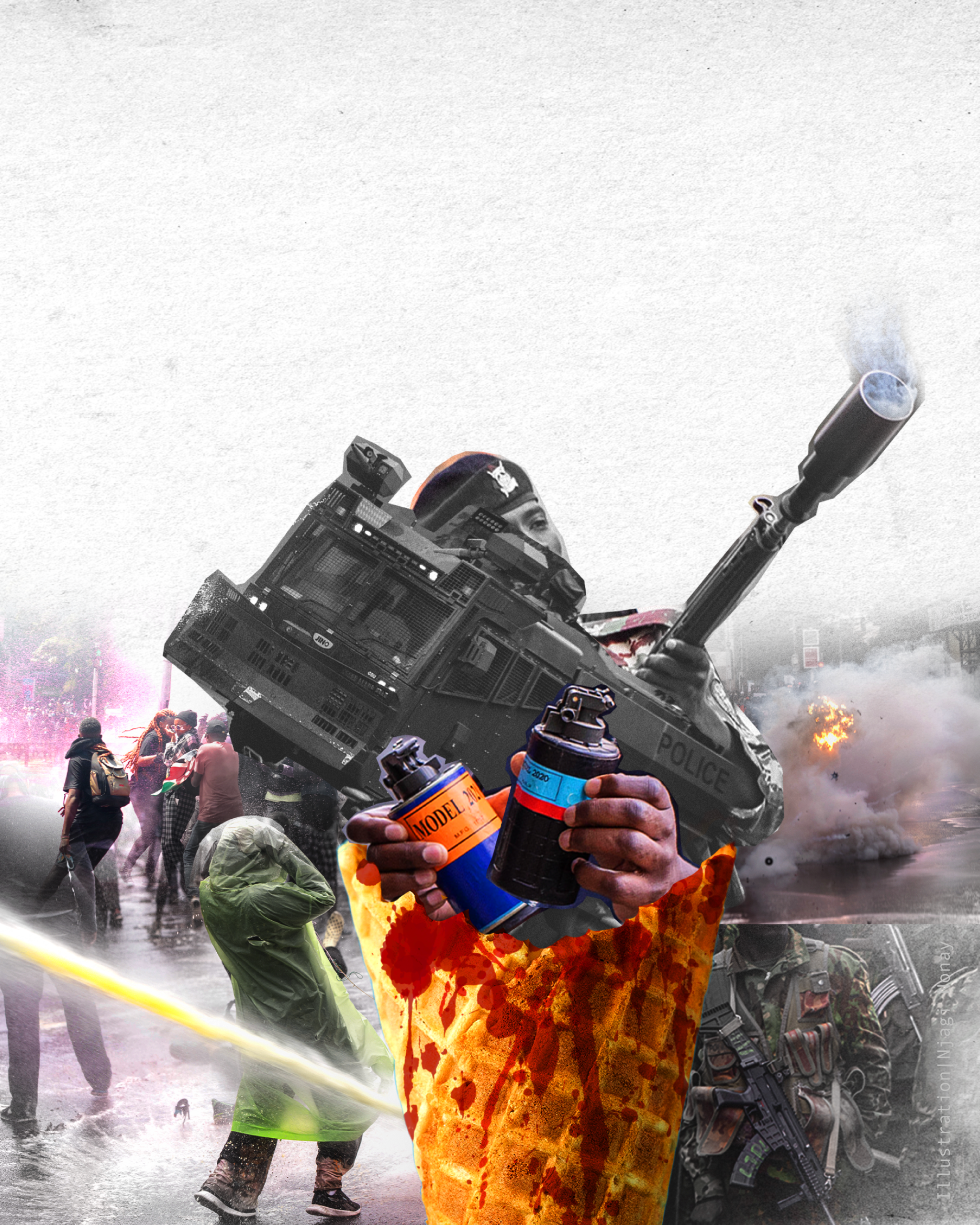
The colour of strawberry icecream, of bubblegum, of little girls’ bicycles, of Barbie and Hello Kitty accessories. For one absurd second it looks festive. Then it hits. The government has found a way to stain us, to mark us for slaughter. People scatter in every direction. Tear gas burns my eyes. “Hii tear gas ya leo ni flavour mpya,” a protester says in the commotion.
The violence meted out today is different.
My lungs tighten. Somewhere in the confusion, we lose Sandra and the other girls. Panic is spreading faster than the gas. The water lingers on the roads after we run. Pink. Sweet-looking. Almost innocent.
Flavour ya Blood
By mid-afternoon, the strawberry has become blood.
Members of Parliament have passed the Finance Bill and the people are livid. What a betrayal. Parliament has been breached and protesters have now entered the grounds. The betrayal must be avenged. The police are responding with bullets.
Dr. Margaret Oyuga is bleeding from her back on the grounds of the house of the Lord. The ambulance can not reach her or is not allowed to reach her or is ferrying members of parliament to safety, from the people, their people. David Chege’s brain matter is scattered outside Parliament, his head covered with a Kenyan flag. I would like to imagine that he did not die alone. That the flag draped over him bent low and whispered into his ear. That it recited the national anthem like a lullaby.
“Nchi yetu ya Kenya,
tunayoipenda,
tuwe tayari kuilinda.”
I would like to imagine that the flag kept singing long after David could no longer hear it.
Across the city, blood was finding blood. Dr. Margaret Oyuga’s blood. David Chege’s blood. The blood of Benson Kigoro. The blood of Erickson Mutisya. The blood of all those whose names we know and the many more whose names we do not know and may never know. Running through church compounds and parliamentary grounds, staining pavements and flags and medics hands alike.
Somewhere between running from tear gas and trying to locate our missing friends, the country changes. We make it briefly into town and the atmosphere feels electric and terrifying all at once.
Police line the Express Way above us, their presence looming and threatening. News is spreading from person to person faster than any broadcaster can keep up. Everybody is watching history happen through their phones while simultaneously living inside it. I keep checking WhatsApp. “Have you seen Sandra?” “Is everyone okay?” “Where are you?” “We are opposite All Saints… sikuskii, hello?”
Eventually, we find one another.
One by one. A text. A phone call. A familiar face emerging from the crowd. It is indisputably time to go. We are lucky enough to get a number 46 mathree heading to Hurlingham. By evening, we are back on Rose Avenue. Shaken. Exhausted. Alive.
The same living room that had held hope that morning now held a heavy silence. Outside, Nairobi continues to burn. I think about the pink water. How strange it was. How childish. How almost sweet. Perhaps that is why I cannot stop thinking about it. Because strawberry is supposed to be the flavour of childhood.


