
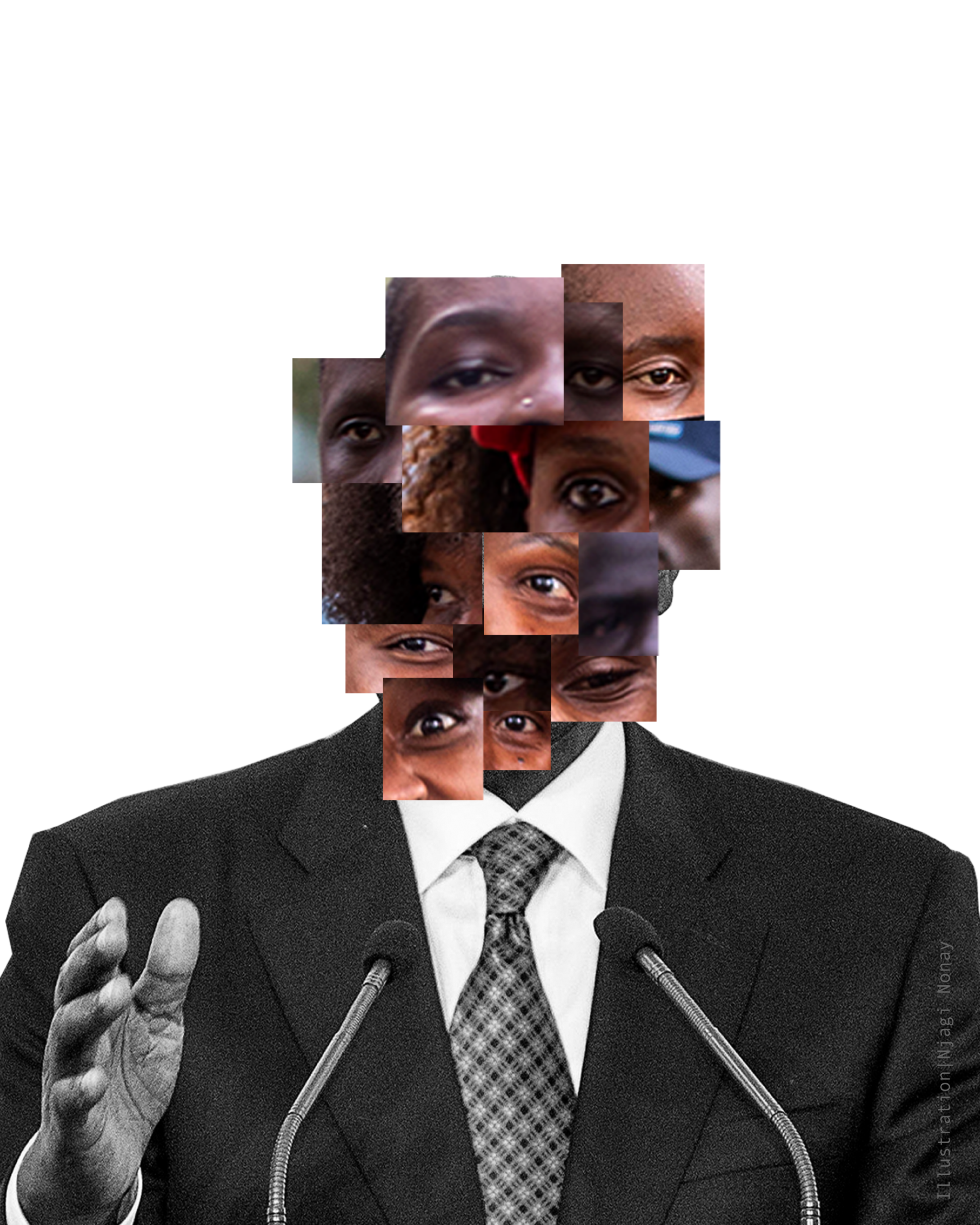
History, they say, is written by victors.
I am not a victor in this story.
A few minutes before 8:00 p.m., I finally drag my broken body past the front door. Not broken-broken. Broken. The body and soul variety. “How was it?” my sister, who cannot help herself, asks. I do not answer. Can’t she tell, or see, or smell, or sense?
I look like I have crawled out of a sewer, and need to be hosed down and thoroughly disinfected. But I feel dizzy. I can no longer stand. The adrenaline has worn off, and I can feel a dull throb in my ankle. I plop onto the living room floor in my dirty, street-stench-damp clothes that reek of tear gas, sweat, and are patchy pink from the potent chemical dye in the water cannon weaponised against us today. My ears are still ringing.
It is now 9:00 p.m. on 25th June 2024.
President William Ruto appears on TV. Impassive, angry, menacing. All performative emotions, I decide. Beneath the mask, vengeance. But also fear and disbelief. Like someone who has felt a premonition of the imminent end to his reign.
A stoic military man stands guard behind him, transfixed. When the President speaks, he is articulate, seething, and does not mince his words. Threats, targeted assurances, ultimatums. He does not speak to the shocked, mourning, distraught nation.
He speaks to himself, I decide.
I read the caption on the TV screen as the Commander-in-Chief of the Armed Forces of the Republic of Kenya speaks.
“Statement by President William Ruto on 25th June 2024,” it reads.
I look down at my swollen purple ankle. I am still resting on the living room floor. The same position I took when I miraculously made it home, hardly an hour ago. My voice is coarse, and my throat hurts when I speak. Everything hurts. I do not want to hear what he has to say. But my limbs are heavy as lead, and exhaustion paralyses me to my spot.
‘‘….An otherwise legitimate expression of the fundamental rights and freedoms of assembly, demonstration picketing, and petitioning of public authorities by a section of law-abiding citizens of the Republic of Kenya was infiltrated and hijacked by a group of organized criminals.’’
But that is not what happened. How I wish I were the grand, existential threat being described. How I wish any of us fit the spiteful image the President was painting. The truth, I feared, was more mundane, more heartbreaking, to and for him.
The previous day, at 4:00 p.m., my HR manager at work says we should work from home the next day, for safety reasons. My boomer boss understands; he wishes us well and encourages us ‘to represent’. I am in my early 20s and freshly employed. I am getting the hang of this tax thing. I am learning that it has not always been like this. I do not even want to go to the protests. I want to be unbothered, ignorant, and 23.
I want the dream I was promised of when systems had a semblance of efficiency. Back when you did not have to incur crippling student debt for higher education. When getting a first-class meant something. When you did not need a connected uncle to land an internship. Back when young people protesting against punitive taxes were not regarded as dangerous criminals who undermined the security and stability of our country.
But it is 8:30 a.m. on Tuesday, 25th June 2025.
William Ruto is the President, and things are bananas. Taxes are ever encroaching on our small paychecks, but when we demand a fair chance at life, we are baited as pawns in a political crossfire. As if I need financiers and planners to protest when the price of mere sanitary pads has almost doubled. I cannot sit by as my generation heeds the call.
It is 9:00 a.m. at the bus stop. I am still 23. But I am not ignorant or unbothered. There is no mistaking where all of us, criminals dressed in dull clothes, are headed. Those with braids secure them as if headed to a gym session, and the masks that remained from the COVID era have finally come in handy. There are few cars on the road and even fewer people. We are not eager to arrive at our destination. The previous week, one of us, Rex Maasai, was gunned down. This hangs heavy on our consciousness.
Our highly organized criminal syndicate boards a nganya that pulls up to the curb. Both the driver and the conductor are in sync with their passengers. Loud music blares from inside the tinted and graffitied nganya. They all belt out Michael Jackson’s They Don’t Care About Us.
“Haya watu wa ku-reject!” the conductor shouts in our general direction, and to the passengers, “Tupendane ndio Zakayo ashuke!”
They laugh. They abide. The passengers, a daring group of 20-somethings, clutch their weapons of choice: Kenyan flags and water bottles. They smile warmly as they squeeze closer together to make room for us. The rowdy lot in the back seats passes a bottle of water around. It is not water. We take turns taking sips. Whatever it is, it is good for the nerves.
Someone’s brother offers to pay bus fare for us all. We cheer, momentarily forgetting the heavy armour, the tanks, and the police barricades we keep passing by on Mombasa Road. It looks like a scene from a movie, where our group is headed towards a restricted war zone. Except this is our country.
Assurances in the aftermath of a bloodbath. So considerate!
It is only midday. It feels as if we have been at it for days. Earlier, when we arrived in the CBD, cops were friendlier. They only watched and monitored as we shouted our chants: “Ruto must go!”, “We are peaceful!”, “Reject, not amend!”. Some even took selfies with us, and we managed to make a few recite our chants. We do not know how long this familiarity, this sense of sisi wote ni Wakenya, will last.
We are a conscientious lot, tribeless, leaderless, we say.
Every so often, someone from within us feels inspired and takes to the front of the crowd or higher ground. Like a congregation testifying on the goodness of the Lord, we take turns leading the chants. Those better skilled in oration take their five minutes of fame to address His Excellency, his functionaries and factotums. Vox populi vox dei. The voice of the people is the voice of God. Or so we imagine.
After all, the President is a born-again Christian.
Maybe, somehow, some of the videos from our street shenanigans find their way to our target audience, His Excellency and the officialdom. Because, at some point in the President’s speech later tonight, we will cease being criminals. In a lucky PR move, a mishap, really, we are addressed with kind and placating words. Followed by the signature tongue-bite telltale, and then a tutatenga promise. Goodness!
As I promised on Sunday, this conversation will not be in vain.
Within the various groups gathered in the CBD, we greet each other. Names are not important; we are all criminals, after all. At least we will be after tonight. But for now, in the streets, we learn small, peculiar things about each other. The young man with the Nike bag will probably get in trouble with his boss tomorrow for skipping work for maandamano, but he had to come. He, too, is 23, bothered, and not ignorant.
Suddenly, it is someone’s birthday. Her name may be Shiku. I will have to protect her identity since it is what criminals do. The guy with the boombox plays Happy Birthday by Rayvanny, a song I ordinarily find uninspiring, but not today. I join the wave and I, too, sway along to the beat. We thank ‘May be Shiku’ for celebrating her birthday with us. Her friends pin the Kenyan flags on her braids, to match her Kenyan flag-themed T-shirt. Birthdays, it seems, cannot wait for lower taxes.
A tear gas canister lands in the middle of our section of the crowd, then another. White, then pink smoke. We scatter. Rubber bullets tear through the chaos. Then actual gunshots. The police are hot on our heels. They descend on us with rungus and whips. I trip over someone who has already fallen, and I, too, go down. I crash hard on bodies, then onto the concrete. My ankle twists. A sharp pain shoots through my left leg. It is loud. Gunshots are closing in. I cannot breathe.
The tear gas has made visibility impossible. I can barely make out the shapes around me. I do not know who is a friend or foe. Someone shouts amidst choking fits that the cops have us cornered. They have barricaded both ends of Kimathi Street.
They are closing in.
‘‘Kiki simama wanacome!’’ my friend pleads, pulling my arm.
Someone else, a stranger, another criminal, grabs my other arm. They help me up. I hop and run with them towards the only building whose entrance remains open. We run up the stairs. We run till we are on the third, maybe fourth floor. Till I can feel my heartbeat in my ears. Till my ankle is numb from the adrenaline. Till someone stops us and ushers us into a nail and hair parlour where a few others are hiding.
The hairdressers, turned citizen journalists, still in their aprons, must not have anticipated the turn their day has taken. They are bearing witness to these treasonous events of the day from a safe-ish distance, the third or fourth floor. They are on TikTok Live, showing the world what is happening. We, too, peer through the open glass windows.
The police corner the remnants of the just-dispersed crowd, and rain blows and kicks on them. A group of journalists – I can tell from their press jackets and cameras – close in on them, coming to bear witness. The victims plead and writhe on the cold, hard concrete pavements as rungus incessantly land on their twenty-something year old bodies. The wielders do not care about the harm they instill. We scream and plead from our vantage point. People slowly return to the scene of the crime.
“Stop killing us!”
“Why are you hitting them?”
“Wacha!”
“Angalia wanatua!”
We shout in an attempt to save our besieged comrades.
We grow bolder and shout louder. The recordings from the hairdressers get better as the camera women close in for better shots. Slowly, the cops retreat, leaving behind battered bodies.
“Most regrettably, today’s attack on Kenya’s constitutional order has resulted in the loss of
He drops the phrase. Loss of lives. Casually. A footnote. A minor occurence. People died. There is no tremor in his voice. No pause for breath. No state or national mourning. The bodies are left cooling on the tarmac, until they are picked in tonight’s clean up. He proceeds to more important issues. Destruction of property. Property. Not people. Property over people.
He does not name them. He cannot. Because if he says David Chege, Erickson Kyalo, Eric Kayoni Shieni, Kelvin Odhiambo Maina, Ibrahim Kamau Wanjiru, Earnest Kanyi, Kenneth Njiru Mwangi, Wilson Sitati, or Beasley Kamau, the illusion of terrorism shatters. He would have to recognise their grieving families who maybe prayed, called, and waited by the door for their kin to return home from maandamano, and listen to this speech. But now they are all murdered treasonous criminals.
The speech marches on. Cold. Mechanical. Completely detached. We will write about this speech. And maybe we will be victors.


