
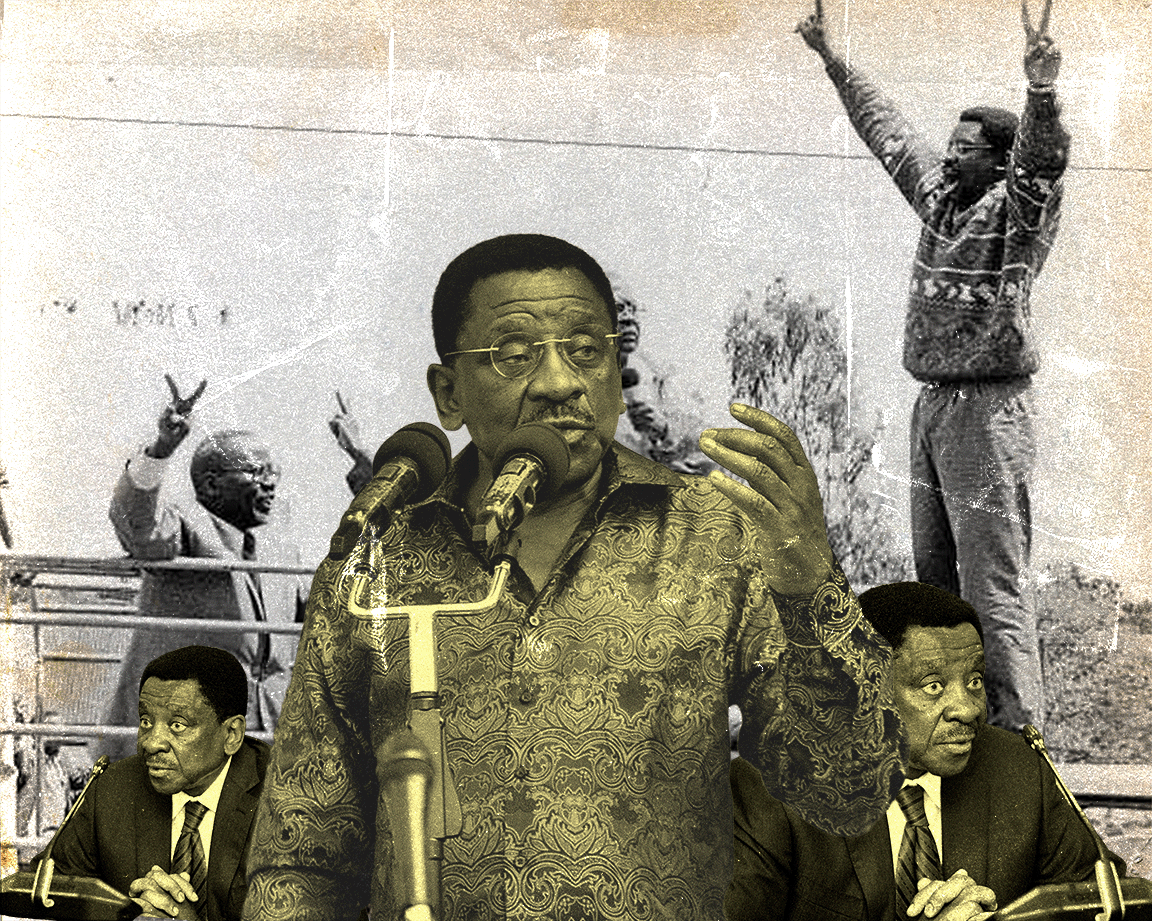
For the longest time, possibly since he joined Twitter (now X), Siaya Governor James Orengo has maintained the same masthead, a photo of a youthful Orengo seated across from and speaking to a suited, bespectacled, mixed-race man who’s spotting an afro full of grey hair.
The photo is simple, innocent, portraying its subjects in a father-son light, Orengo seeming to be articulating an important thought to the old man, the old man listening pensively, patiently, his hands categorically interlocked, as if whatever the old man is about to say next will determine a fate or fates of things and people somewhat, somehow, somewhere. The poignancy is palpable.
But then the photo starts losing its innocence when one begins connecting the dots.
If there is a Kenyan politician with some of the most poetic and historically consequential photos – from student leadership in the early ‘70s to the fight against dictatorships in the late ‘70s and early ‘80s, to the struggle for pluralism in the late ‘80s to the early ‘90s, to the push for reforms and the midwifing of a new politics in the late ‘90s and early 2000s, to the clamour for electoral justice in the naughts and beyond – that individual is James Bob Aggrey Orengo.
But then, Orengo deliberately picked this particular photo of himself with a man who is certainly unrecognizable to possibly 99% of Kenyans, when he could easily have settled for any one of his many iconic and recognizable photos, including one with his political father, Jaramogi Oginga Odinga. His X account being his most populated contact site with over one and a half million followers at present, Orengo knew and knows what he is doing with that masthead, whether the Kenyan public recognizes the man in the photo with Orengo or not. Orengo, it seems, was picking the photo more for himself than for the public, but not anymore.
The man in the photo with Orengo is Walter Max Ulyate Sisulu.
The photo is no longer innocent.
For the longest time – as long as the Governor has had the masthead of himself and Sisulu – I have always had suspicions as to what exactly he was and is trying to say – because a photo is worth a thousand words. And much as I had my own strong suspicions – that Orengo was taking a public stand to say his politics is the politics of Walter Sisulu, that he is a Sisuluist – I never wanted to put words in the Governor’s mouth, and so I always withheld any grand conclusions and only entertained a surface-level interpretation – that James Orengo simply admired Walter Sisulu, and possibly simply wanted to celebrate the self-effacing man’s legacy publicly.
But then during an animated interview with Citizen TV’s Jeff Koinange on his Jeff Koinange Live on Wednesday, a buoyant Orengo did something he rarely does – made a deliberate effort to elucidate exactly what he and his comrades seek to achieve through their Linda Mwananchi movement.
In a nutshell, Orengo’s mission is to build a movement, a party akin to the African National Congress, so powerful and with deep structures such that it can recall the country’s president if the said president were elected on the party’s platform, just like the ANC has done twice.
‘‘A party like the ANC…’’ Orengo said multiple times.
Aside from the strong party, Orengo volunteered that his view and that of his comrades is to build a movement that defies the ethnic arithmetic curse that has bedevilled Kenyan politics, so that even in building political alliances with contemporary opposition forces, the conversation will not be about who brings what numbers from what ethnic group followed by the slicing up of government positions to be gifted to the various ethnic barons, but rather a conversation about unity of purpose in pursuing an organic and progressive national political project for the masses.
Further, Orengo referenced the ANC’s most important political document, the Freedom Charter, arguing that his Linda Mwananchi movement and other political players who think like them must present to the people of Kenya a comprehensive program which will form a political roadmap around which to rally the country.
Asked why he pronounced himself the de facto acting party leader of the Orange Democratic Movement, to which Linda Mwananchi belongs, for now, Orengo once again went back to the ANC, equating his move to Nelson Mandela’s assumption of a parallel leadership of the ANC during the defiance campaign, when seeing that Chief Albert Luthuli’s overall leadership was not aiding the escalation the moment called for, so that Mandela participated in the formation of the Umkhonto We Sizwe fighting force, and took its leadership.
To Orengo, there is always precedence – inside the ANC.
And so there is no denying it. James Orengo is a loyal student of the ANC.
No wonder the enduring Walter Sisulu masthead.
But then, if the ANC is Orengo’s North Star, then why doesn’t he, like many would, go for a Nelson Mandela masthead, for instance? Or is it that he never met Mandela, or he met him but never took a photo with him? Or is it that he only met and took a photo with Sisulu?
To answer these questions, one has to go a little further, like Orengo must have.
Indeed, the likes of Nelson Mandela are better known, but were they the most consequential leaders in the ANC? In apportioning credentials, it must be noteworthy that it is Walter Sisulu who recruited a young Nelson Mandela into the ANC, and stayed by his side, lifting him up, encouraging him, even paying his bills before Mandela found his footing, until they formed the ANC’s fighting force, the Umkhonto We Sizwe, which Sisulu and others asked Mandela to lead.
Sisulu was Mandela’s political twin, the elder twin, just as he was his comrade.
But then Orengo doesn’t stop there. He digs deeper on Sisulu.
‘‘I was once told that the Sisulu family is South Africa’s first family,’’ Orengo told Koinange.
Still in the crosscutting interview, and in seeking to make the point that the new movement he and his comrades are trying to build must transcend personalities – like the ANC, in Orengo’s words – Orengo divulged that once upon a time, he was seated with Nelson Mandela and Walter Sisulu, when Sisulu informed them that when Sisulu and others picked Mandela to be president of South Africa, they had done so on their terms – meaning the terms of the ANC top leadership and the terms of the people of South Africa. Mandela was the sitting president, and Orengo thought Sisulu had gone overboard in saying whatever he said in Mandela’s presence – that Mandela did not become president out of his own doing, but that they, the collective at the top, had basically handed Mandela the presidency, because he was simply a comrade. But then, that was the ANC’s golden era, where Mandela, with all his glory, was simply another comrade.
This, in Orengo’s thinking, is what Kenya needs.
No big personality. No saviour. Just comrades who pick one of their own, on their terms.
But maybe Sisulu could say these things to Mandela because he, Sisulu, had shown that he could transcend the pursuit of power and glory and self gratification and instead choose to serve a bigger cause. Having been imprisoned alongside Mandela for 25 years at Robben Island, and having risen to the highest positions within the ANC – having been secretary general and deputy president respectively – when the ANC took power and most senior comrades became ministers and deputy ministers and so on, Sisulu opted to not take any official government position, choosing to instead play outsider. Not many can muster this sort of self-sacrifice.
Maybe, just maybe, James Orengo knew Sisulu in deeper ways than most.
And so, with his Sisulu masthead, Orengo must have surely drunk from the wells of the wise, the ideologically committed – Sisulu was a member of the South African Communist Party – historical figures who were larger than life but who chose to remain mere mortals, and Orengo now has the task to transplant these ideas, these practices, in a Kenya that is so ideologically bankrupt, so that the word ideology seems dirty, farfetched, elitist and unnecessary, reeking of intellectual snobbery. This is Orengo’s near-impossible historical assignment.
And yet the masthead persists, the struggle continues.
At 76, James Orengo has continued to embody a spirit of comradeship so rare in our midst, that one wonders why he does this, and for what? Like when Vihiga Senator Godfrey Osotsi was recently assaulted by a marauding gang in Kisumu, Orengo made several trips to the police station in Kisumu, seeking justice for the Senator. Or when he recently accompanied Embakasi East MP Babu Owino to the Directorate of Criminal Investigations, to inquire about the fate of one of Babu’s bodyguards, who they claim has been a victim of harassment by the police.
But what takes the absolute crown in James Orengo’s embodiment of comradeship is how Orengo, a sitting governor who is supposed to be swimming in largesse, has chosen to set that aside and join Linda Mwananchi, the firebrand faction within his Orange Democratic Party which seeks to maintain the party’s vigour and valour and safeguard its pro-struggle credentials.
Every other weekend, Orengo joins legislators the age of his children as they surmount police barricades and face-off with political goons, in their bid to preach the Linda Mwananchi gospel. His fellow governors and other senior politicians must look at Orengo with both admiration and astonishment. And yet, without Orengo, Linda Mwananchi loses an ideological godfather and with it a legitimacy which Orengo has built with blood, sweat and tears for the last five decades.
With the Sisulu masthead still in place, James Orengo’s herculean task will be how to turn his comrades within Linda Mwananchi and the broader opposition into Sisuluists like himself. Will they have the time to devour political literature and revisit the stories of the ANC trenches and treacherous moments in exile, for them to form a substantive North Star for Linda Mwananchi?
Will he make Babu Owino, Edwin Sifuna, Godfrey Osotsi, and others, read about Joe Slovo, and realize that much as Sisulu was political royalty, and much as Mandela was the primus inter pares, there were many others who were more radical, more consequential. Will he feed them on Robert Sobukwe, and encourage them to adopt Chris Hani’s fighting spirit?
And how is James Orengo going to translate these hard core ideological positions into bite size beats which he can deliver in 50 seconds at political rallies? Will he manage to convince the leaders of various opposition groupings into buying it this almost impossible Sisuluist project?
James Orengo still has Walter Sisulu on his masthead.
Who will his comrades have on their mastheads?
The struggle, it seems, has just begun.


